Trail Making Test
System Requirements
Minimum: 800×600
Recommended: 1280×800
Description
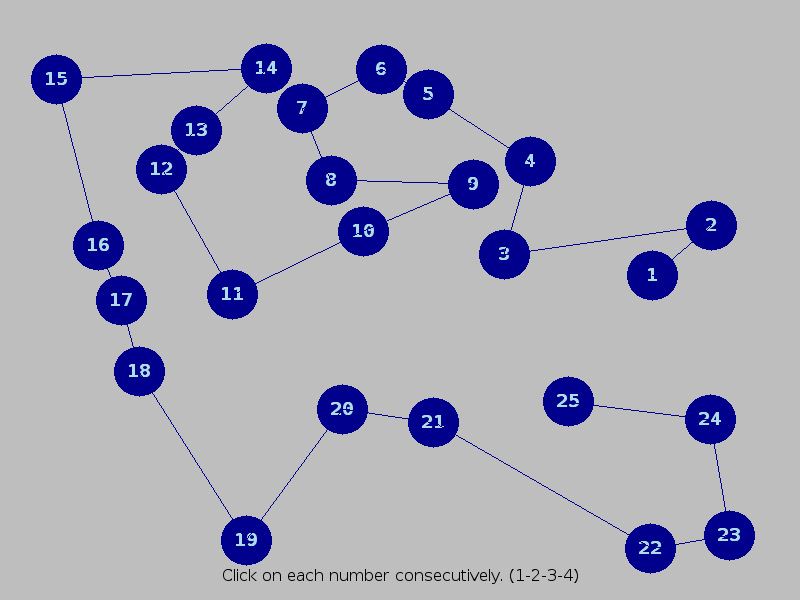
A test of visual search, attention, mental flexibility, and motor function where participants connect numbered or lettered circles in sequence as quickly as possible.
About This Test
The Trail-making test is used for detecting brain injury and assessing eye-hand coordination and procedural skill. The most common version is by Reitan (Halstead-Reitan Battery), but it dates back to tests like the Taylor Number Series and Partington Pathways test from WWII Army testing batteries. The PEBL version can use either Reitan's original configurations or automatically-generated sets of new problems (default and recommended). Auto-generated problems allow more runs for better reliability and run each problem in both forms (A and B) with reflected points to obscure similarity, providing better comparison between forms.
- Classic Reitan points have paths set up so they do not cross. For randomly-generated points, paths are likely to cross.
- Auto-generated version (default) is recommended for better reliability and improved form comparison.
Test Details
ptrailsptrails.pbl🚀 Try Without Registration
Run this test immediately without creating an account. Data stays in your browser.
Researcher Access Benefits
To save configurations, upload data, use translations, track completion, and manage studies, please log in or register for an account.
Scientific Background
Original Task References:
These references describe the original task that this PEBL implementation is based on.
- Atkinson, T. M., & Ryan, J. P. (2008). The use of variants of the Trail Making Test in serial assessment: A construct validity study. Journal of Psychoeducational Assessment, 26(1), 42-53. doi:10.1177/0734282907301592
- Buck, K. K., Atkinson, T. M., & Ryan, J. P. (2008). Evidence of practice effects in variants of the Trail Making Test during serial assessment. Journal of Clinical & Experimental Neuropsychology, 30(3), 312-318.
PEBL-Specific References:
These studies used the PEBL version of this task.
- Piper, B. J., Li, V., Eiwaz, M. A., Kobel, Y. V., Benice, T. S., Chu, A. M., Olsen, R. H. J., et al. (2011). Executive function on the Psychology Experiment Building Language tests. Behavior Research Methods. doi:10.3758/s13428-011-0096-6
Data Output
ptrails-{subnum}.csv
Scoring and Interpretation
Form A (numbers): Total completion time (totaltime) for numbers-only sequencing.
Form B (letters+numbers): Total completion time for alternating sequence - measures cognitive flexibility and task switching.
B-A difference: Difference between Form B and Form A times indicates switching cost.
Efficiency: Accuracy (acc) should be 1.0 for perfect performance (clicks = targs).
Longer times and lower efficiency indicate impaired visual search, motor speed, or executive function.
Example Data
ptrails-example.csv Detail
Click-by-click log showing every mouse click during the test
| subnum | trial | blocktype | type | clicks | hits | clicktime | posx | posy | corr | id | rt | rt2 |
|---|---|---|---|---|---|---|---|---|---|---|---|---|
| aaaaa | 1P | practice | number | 1 | 1 | 4510 | 1048 | 375 | 1 | 1 | 962 | 962 |
| aaaaa | 1P | practice | number | 2 | 2 | 4981 | 929 | 412 | 1 | 2 | 471 | 471 |
| aaaaa | 1P | practice | number | 4 | 2 | 6275 | 1015 | 455 | 0 | 4 | 1294 | 1294 |
| aaaaa | 1P | practice | number | 5 | 3 | 6936 | 1050 | 514 | 1 | 3 | 661 | 1955 |
| aaaaa | 1P | practice | number | 6 | 4 | 7259 | 1007 | 451 | 1 | 4 | 323 | 323 |
| aaaaa | 1 | test | number | 1 | 1 | 8912 | 1297 | 274 | 1 | 1 | 1113 | 1113 |
| aaaaa | 1 | test | number | 2 | 2 | 9348 | 1220 | 267 | 1 | 2 | 436 | 436 |
| aaaaa | 1 | test | number | 3 | 3 | 9925 | 1031 | 268 | 1 | 3 | 577 | 577 |
| aaaaa | 1 | test | number | 4 | 4 | 10396 | 1137 | 238 | 1 | 4 | 471 | 471 |
ptrails-summary-example.csv Summary
One row per trial with aggregate performance metrics
| sub | blocktype | type | distance | studytime | totaltime | mediantime | targs | clicks | acc |
|---|---|---|---|---|---|---|---|---|---|
| aaaaa | practice | number | 330.285 | 962 | 2749 | 716.5 | 4 | 6 | 0.666667 |
| aaaaa | test | number | 3432.3 | 1113 | 20347 | 594.5 | 26 | 27 | 0.962963 |
| aaaaa | practice | letter | 420.115 | 1202 | 1912 | 766.5 | 4 | 4 | 1 |
| aaaaa | test | letter | 3432.3 | 1372 | 18647 | 590.5 | 26 | 26 | 1 |
| aaaaa | practice | alternating | 353.572 | 1434 | 1215 | 428.5 | 4 | 4 | 1 |
| aaaaa | test | alternating | 3338.74 | 1226 | 20235 | 618 | 26 | 30 | 0.866667 |
| aaaaa | practice | number | 528.071 | 1580 | 1800 | 650 | 4 | 4 | 1 |
| aaaaa | test | number | 3338.74 | 1064 | 16197 | 555 | 26 | 28 | 0.928571 |
| aaaaa | practice | letter | 498.012 | 1390 | 1660 | 612 | 4 | 4 | 1 |
ptrails-report-example.html Report
HTML report with formatted tables showing trial details and summary statistics with embedded CSS styling
📊 Interactive HTML Report Preview Open in new window →
Sample data showing typical output format. Actual values will vary by participant.
About This Test
A test of visual search, attention, mental flexibility, and motor function where participants connect numbered or lettered circles in sequence as quickly as possible.
Category: Executive Function
Estimated Duration: 10 minutes
Available Translations: 8 languages
Documentation Sources:
Test description file, Test implementation, Parameter schema
Documentation Status: Complete