NASA Task Load Index (TLX)
System Requirements
Minimum: 800×600
Recommended: 1024×768
Description
A multidimensional assessment tool for measuring subjective workload across six dimensions
About This Test
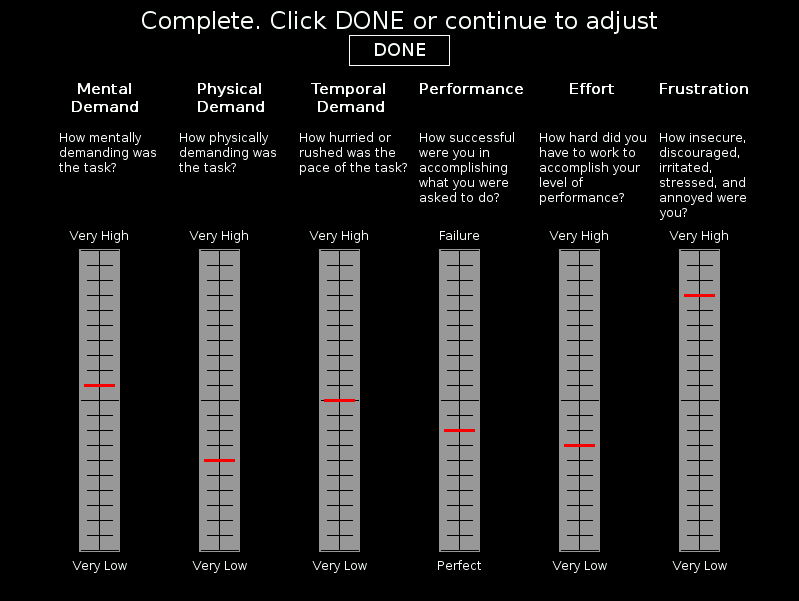
The NASA Task Load Index (TLX) is a widely-used multidimensional assessment tool that provides an overall workload score based on a weighted average of ratings on six subscales: Mental Demand, Physical Demand, Temporal Demand, Performance, Effort, and Frustration. The standard TLX includes optional pairwise comparisons to weight the dimensions, though weights are often omitted in practice. This implementation presents each dimension on a visual analog scale and records both ratings and response times. The task name can be customized to reference the activity being rated.
Test Details
TLXTLX.pbl🚀 Try Without Registration
Run this test immediately without creating an account. Data stays in your browser.
Researcher Access Benefits
To save configurations, upload data, use translations, track completion, and manage studies, please log in or register for an account.
Scientific Background
Original Task References:
These references describe the original task that this PEBL implementation is based on.
- Hart, S. G., & Staveland, L. E. (1988). Development of NASA-TLX (Task Load Index): Results of empirical and theoretical research. In P. A. Hancock & N. Meshkati (Eds.), Human Mental Workload (pp. 139-183). Amsterdam: North-Holland.
- Hart, S. G. (2006). NASA-Task Load Index (NASA-TLX); 20 years later. Proceedings of the Human Factors and Ergonomics Society Annual Meeting, 50(9), 904-908.
Data Output
Outputs subject-specific CSV file with ratings and optional weights for all six dimensions, plus pooled data file aggregating all participants. Data includes dimension ratings (1-21 scale), optional weights (0-5, sum to 15), and response times.
Key Variables
| Variable | Description |
|---|---|