System Usability Scale
System Requirements
Minimum: 800×600
Recommended: 1024×768
Description
A standardized 10-item questionnaire for assessing the perceived usability of systems, interfaces, and products
About This Test
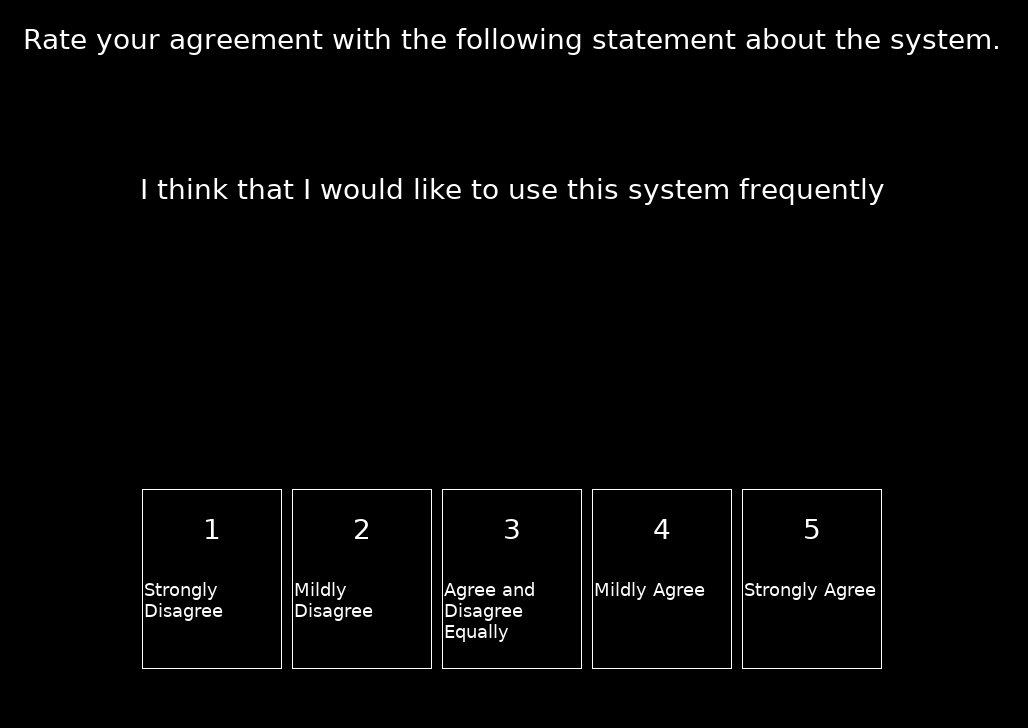
The System Usability Scale (SUS) is a widely-used standardized questionnaire for assessing the perceived usability of systems, interfaces, and products. The scale consists of 10 items with five response options from 'Strongly Disagree' to 'Strongly Agree'. The SUS yields a single score ranging from 0 to 100, with higher scores indicating better usability. This implementation presents each question individually with a visual Likert scale interface, recording both responses and response times for each item.
Test Details
SUSSystemUsabilityScale.pbl🚀 Try Without Registration
Run this test immediately without creating an account. Data stays in your browser.
Researcher Access Benefits
To save configurations, upload data, use translations, track completion, and manage studies, please log in or register for an account.
Scientific Background
Original Task References:
These references describe the original task that this PEBL implementation is based on.
- Brooke, J. (1996). SUS: A 'quick and dirty' usability scale. In P. W. Jordan, B. Thomas, B. A. Weerdmeester, & I. L. McClelland (Eds.), Usability evaluation in industry (pp. 189-194). London: Taylor & Francis.
- Bangor, A., Kortum, P. T., & Miller, J. T. (2008). An empirical evaluation of the System Usability Scale. International Journal of Human-Computer Interaction, 24(6), 574-594.
Data Output
Outputs subject-specific CSV file with individual responses and response times for all 10 items, plus pooled data file aggregating all participants. Data can be used to calculate standard SUS scores (0-100 scale).
Key Variables
| Variable | Description |
|---|---|