Short Stress State Questionnaire (SSSQ)
System Requirements
Minimum: 800×600
Recommended: 1024×768
Description
A 24-item self-report questionnaire measuring transient stress states during task performance
About This Test
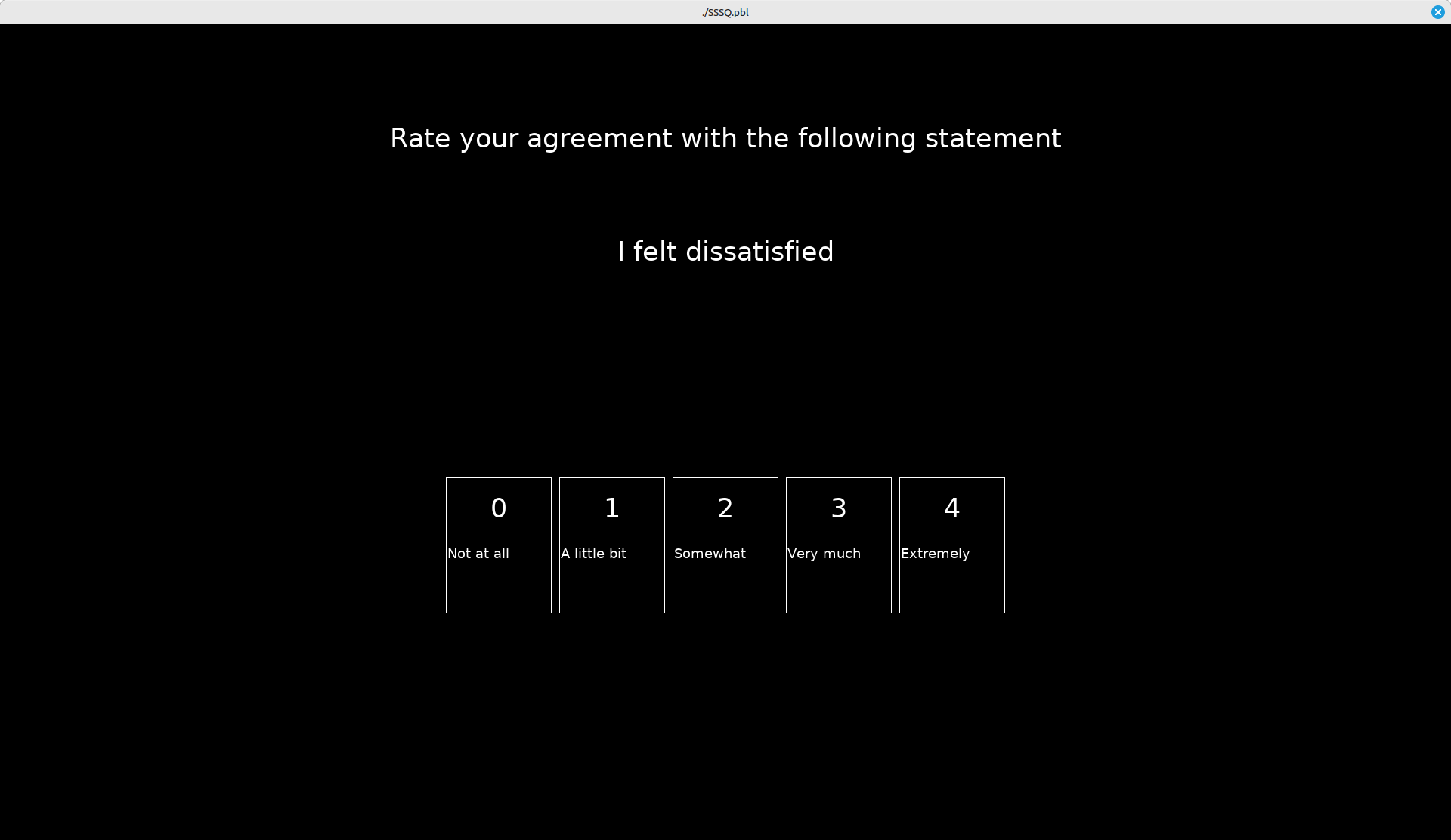
The Short Stress State Questionnaire (SSSQ) is a brief self-report instrument designed to assess transient stress states experienced during or immediately after task performance. Participants rate 24 statements on a 5-point Likert scale ranging from 'Not at all' (0) to 'Extremely' (4). The SSSQ assesses multiple dimensions of task-induced stress: - **Distress**: Negative emotional states (dissatisfaction, depression, sadness, anger, irritation) - **Task Engagement**: Motivation, commitment, and alertness during the task - **Worry**: Self-focused attention and concerns about performance - **Self-Focused Attention**: Reflection about oneself and social evaluation concerns Each item is presented individually on screen, and both ratings and response times are recorded. This implementation follows the original SSSQ format but presents items sequentially rather than as a paper questionnaire.
Test Details
SSSQSSSQ.pbl🚀 Try Without Registration
Run this test immediately without creating an account. Data stays in your browser.
Researcher Access Benefits
To save configurations, upload data, use translations, track completion, and manage studies, please log in or register for an account.
Scientific Background
Original Task References:
These references describe the original task that this PEBL implementation is based on.
- Helton, W. S., & Warm, J. S. (2008). The Short Stress State Questionnaire. In D. de Waard, F. O. Flemisch, B. Lorenz, H. Oberheid, & K. A. Brookhuis (Eds.), Human Factors for Assistance and Automation (pp. 5-14). Maastricht, the Netherlands: Shaker Publishing.
- Matthews, G., Campbell, S. E., Falconer, S., Joyner, L. A., Huggins, J., Gilliland, K., Grier, R., & Warm, J. S. (2002). Fundamental dimensions of subjective state in performance settings: Task engagement, distress, and worry. Emotion, 2(4), 315-340.
Validation status: Well-validated instrument with established psychometric properties. Widely used in human factors and engineering psychology research.
Typical Use Cases
- Human factors research
- Vigilance and sustained attention studies
- Workload assessment
- Task-induced stress measurement
- Pre/post task stress evaluation
- Cognitive ergonomics research
- Performance prediction studies
Data Output
SSSQ-{subnum}.csv
Data Columns
| Column Name | Description |
|---|---|
| subnum | Participant ID |
| timestamp | ISO timestamp of test completion |
| q1-q24 | Responses to 24 items (0-4 scale: 0=Not at all, 1=A little bit, 2=Somewhat, 3=Very much, 4=Extremely) |
| t1-t24 | Response times in milliseconds for each of the 24 items |
Scoring and Interpretation
Distress (items 1, 3, 4, 6, 7, 8, 9, 10): Sum of negative emotion items. Higher scores indicate greater distress.
Task Engagement (items 2, 5, 11, 12, 13, 17, 21, 22): Sum of motivation and alertness items. Higher scores indicate greater engagement. Note: Some items may need reverse scoring (consult original validation studies).
Worry (items 14, 15, 16, 18, 19, 20, 23, 24): Sum of self-focused attention and performance concern items. Higher scores indicate greater worry.
Consult the original Helton & Warm (2008) and Matthews et al. (2002) references for detailed scoring procedures and subscale definitions.
Example Data
| subnum | timestamp | q1 | q2 | q3 | q4 | q5 | q6 | q7 | q8 | q9 | q10 | q11 | q12 | q13 | q14 | q15 | q16 | q17 | q18 | q19 | q20 | q21 | q22 | q23 | q24 | t1 | t2 | t3 | t4 | t5 | t6 | t7 | t8 | t9 | t10 | t11 | t12 | t13 | t14 | t15 | t16 | t17 | t18 | t19 | t20 | t21 | t22 | t23 | t24 |
|---|---|---|---|---|---|---|---|---|---|---|---|---|---|---|---|---|---|---|---|---|---|---|---|---|---|---|---|---|---|---|---|---|---|---|---|---|---|---|---|---|---|---|---|---|---|---|---|---|---|
| 21525 | Sat Nov 1 16:48:32 2025 | 2 | 3 | 4 | 5 | 4 | 3 | 2 | 1 | 1 | 4 | 5 | 3 | 1 | 2 | 3 | 4 | 5 | 3 | 3 | 1 | 2 | 4 | 5 | 5 | 1413 | 425 | 377 | 381 | 262 | 255 | 199 | 184 | 247 | 391 | 207 | 222 | 229 | 445 | 204 | 198 | 226 | 370 | 202 | 302 | 343 | 245 | 200 | 300 |
Sample data showing typical output format. Actual values will vary by participant.
About This Test
A 24-item self-report questionnaire measuring transient stress states during task performance
Category: Personality & Rating Scales
Estimated Duration: 5 minutes
Available Translations: 1 language
Documentation Sources:
Test description file, Test implementation, Parameter schema
Documentation Status: Complete