PEBL Hub — IRB Fact Sheet — 2026-10-08
Spatial Cueing (Posner) Task
Attention
Category:Attention
Duration:~8 minutes
Parameters:6 configurable parameters available
Version:1.0
Description
A classic spatial cueing paradigm (Posner's cueing task) measuring attentional orienting via valid, invalid, and neutral cues.
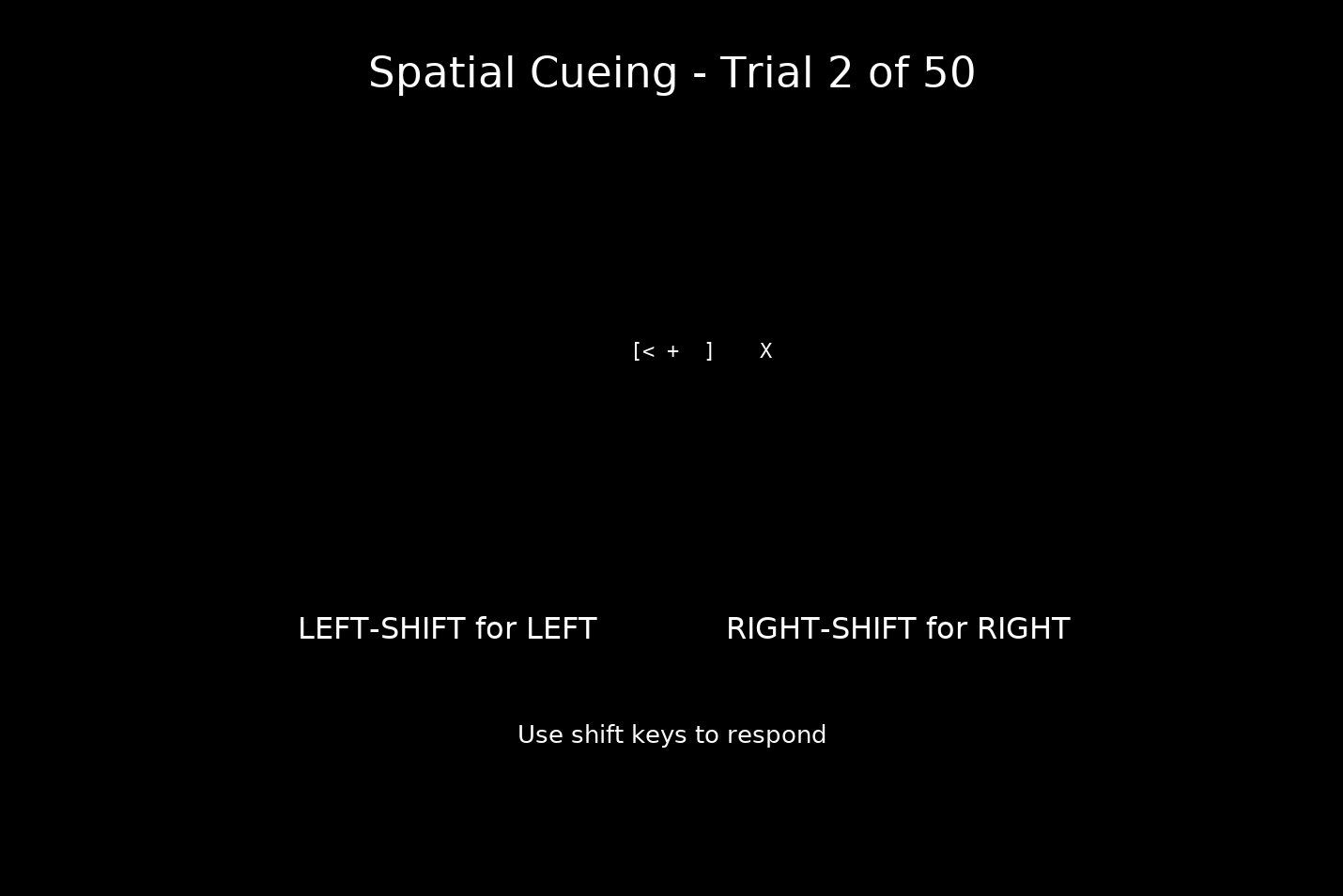
A fixation cross appears with a directional arrow cue (left, right, or both). After a variable delay, a target X appears to the left or right. Participants respond as quickly as possible when the target appears. The arrow cue is valid (correctly predicts target location) on most trials, creating a cueing benefit for valid trials and a cost for invalid trials.
Measures: Attentional orienting, cueing benefit/cost, simple reaction time
Key Parameters
| numValid | Number of Valid stimuli per side (default: 15) |
| numInvalid | Number of Invalid stimuli per side (default: 5) |
| numNeutral | Number of neutral stimuli per side (default: 5) |
| fontsize | Font size of stimuli (default: 22) |
| reps | Number of repetitions of the design. (default: 4) |
| responsemode | Response method for simple RT: auto (platform-aware), spacebar, leftclick (mouse), touchscreen (default: auto) |
Example Data Output (5 sample rows)
| subnum | trial | cue | stim | correct | delay | rt |
|---|---|---|---|---|---|---|
| 111 | 1 | 1 | 1 | 1 | 482 | 109 |
| 111 | 2 | 0 | -1 | 0 | 283 | 41728 |
| 111 | 3 | 1 | 1 | 1 | 212 | 725 |
| 111 | 4 | 1 | -1 | 0 | 93 | 414 |
| 111 | 5 | 1 | 1 | 1 | 544 | 294 |
References
Posner, M. I. (1980). Orienting of attention. Quarterly Journal of Experimental Psychology, 32, 3-25.
Posner, M. I., Snyder, C. R. R., & Davidson, B. J. (1980). Attention and the detection of signals. Journal of Experimental Psychology: General, 109, 160-174.
Mueller, S. T. (2011). The PEBL Spatial Cueing Task. Computer software retrieved from http://pebl.sf.net/battery.html